25/06/2026 • 6 min read

How Kognity makes Monday mornings more manageable at SUIS Gubei
Profile
Nenad Nikolic is Head of Physics at Shanghai United International School, Gubei Campus (SUIS Gubei), an international school in Shanghai serving around 800 students across IGCSE and the IB Diploma Programme. The community is genuinely international, with a significant share of students learning in their second language. Nenad and his department of seven physics teachers have been using Kognity for four years.
Results snapshot
The SUIS Gubei physics department has cut hours from weekly grading, replaced static textbooks with a continuously updated digital resource, and made independent study accessible to every student, including the school’s many EAL learners. Kognity is now the department’s go-to for planning, assessment, and revision.
Key Challenges
- Grading homework and giving thoughtful, personal feedback was consuming a disproportionate share of teachers’ time
- Static, traditional textbooks couldn’t keep pace with how physics evolves, or with how today’s students prefer to learn
- A lot of students were studying physics in their second language, where dense textbook prose was often a barrier
- Lesson planning windows were tight, and didn’t always leave room to build a coherent narrative for complex topics from scratch
- Identifying class- and student-level weak spots before exams meant pulling evidence together by hand, as did informing conversations with parents
Faster, more targeted feedback without the grading pile
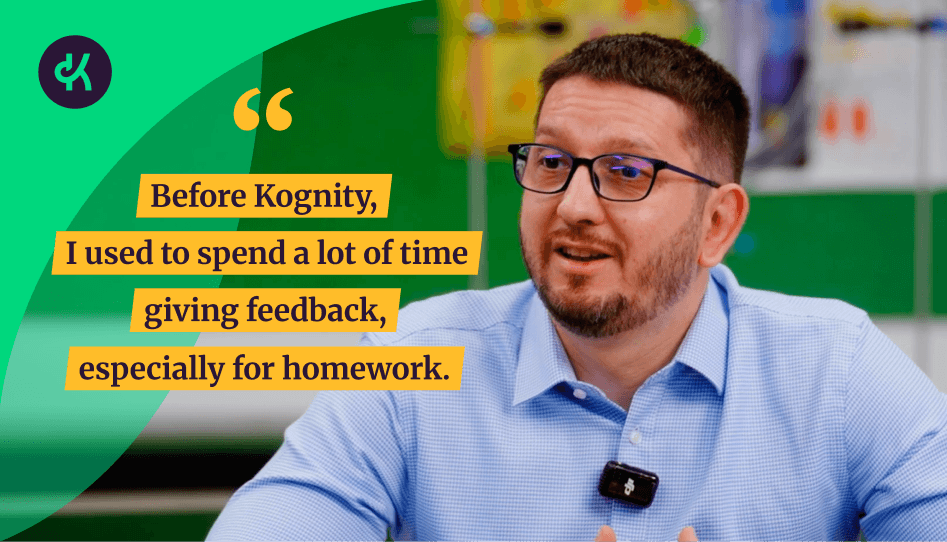
For Nenad, grading homework and giving meaningful feedback was one of the most time-consuming parts of teaching. Students needed personal, specific responses; the available grading time rarely matched the volume.
When it’s Monday morning, you have three periods in a row, you don’t have time to go through all the homework. That’s where Kognity helps the most.
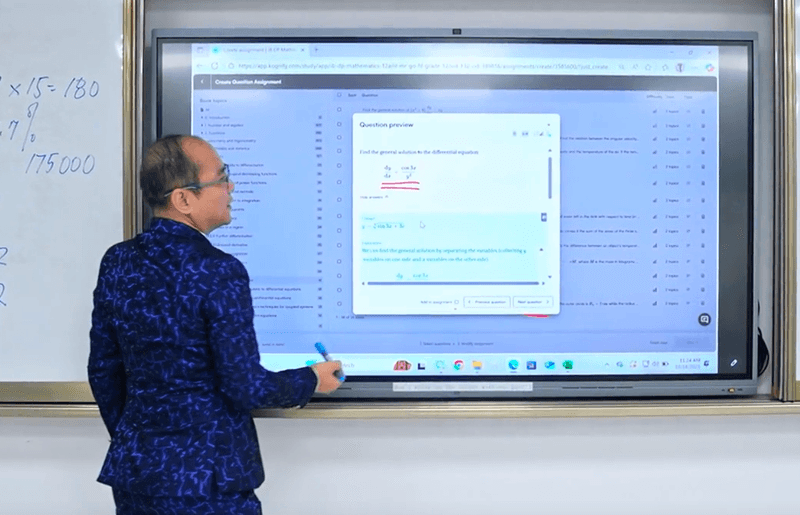
Kognity’s question assignments and real-time reports change the shape of that workflow. By 8:30 am, Nenad has a clear breakdown of who completed the homework, what each student answered, and which concepts the class missed as a whole. The grading is done; the analysis is ready.
In class, that means feedback can zoom in on what students actually got wrong. “Everything else they understood,” he notes, freeing lesson time to focus on the genuine gaps.
A textbook that keeps up with the science and the students
Before Kognity, Nenad’s department was working with traditional textbooks that went out of date the moment they arrived, and that students simply didn’t engage with.
At the beginning, when we started using Kognity, we found it very easy thanks to all the explanatory videos on the platform. Switching from old-fashioned textbooks was stress-free.
The digital format gives the department a textbook that evolves in step with the field. Simulations, videos, and interactive elements replace static diagrams, better serving students who are no longer excited by traditional resources.
Built-in support for EAL learners
SUIS Gubei is genuinely international, and a significant share of its students study in English as a second or third language. For physics specifically, dense textbook prose was often a bigger barrier than the physics itself.
Kognity’s in-text vocabulary support, translation, and text-to-speech tools help students resolve language issues without leaving the page. They can also study at their own pace, replaying a video, sitting longer with a simulation, or checking a definition the moment they need it.
Some of our students are not native English speakers. The vocabulary feature is very, very useful for them.
The result is students who can read and study independently, while the platform – rather than the teacher – absorbs the language interruptions that used to slow lessons down.
From blank page to a strong lesson, faster
Even experienced teachers face the occasional topic where the big picture doesn’t come together quickly enough. Nenad’s example is recent and small, but telling: a lesson on standing waves where, ahead of class, the structure simply wasn’t clicking.
Kognity’s coverage of the topic gave him a frame to build around, and the pre-built simulations and videos provided the visual heavy-lifting.
After reading Kognity, I put all the pieces together and had a great lesson together with videos and simulations. It went out perfect.
The same scaffolding helps new teachers joining the department find their feet quickly. With curriculum-aligned content already in place, they have a structured starting point rather than a blank canvas to fill.
Sharper revision and clearer parent conversations
By the end of the year, every department wants to know exactly where its cohort needs more support. For Nenad, that used to mean assembling evidence by hand. Now, an end-of-year assignment covering all topics, paired with Kognity’s Insights tab, surfaces the weak spots automatically.
Exam preparation itself is more engaging, too. Strength Tests give students a self-paced way to check their understanding, and Strength Battles turn the same content into a class competition. Nenad has used the format to good effect, complete with a “Strength Battle Cup” winner at the end.
The same Insights data also informs parent meetings.
In the physics department, we find Insights a very useful tool to gather data from students. It’s especially useful during teacher-parent conferences, where we can give parents more targeted feedback on how their kids are doing.

A department-wide go-to
All seven physics teachers at SUIS Gubei use Kognity, and Nenad credits it with reducing the daily pressure on the team while raising the quality of student support. Students, he says, have responded in kind: they “love” the platform for the interactivity and independence it gives them.
At Shanghai United International School, Gubei Campus, we care about teachers’ well-being and work-life balance. Kognity is a great tool that helps us in that a lot. It significantly reduces the time teachers spend giving feedback for homework, and helps them deliver their lessons more efficiently.
For Nenad, four years in, the verdict is simple: “I’m honestly thankful that I have Kognity.”
Customer Stories