From Abstract to Alive: How Edison High School Brought Chemistry to Life with Kognity
Snapshot
Since adopting Kognity for Chemistry, Edison High School has seen the percentage of students meeting or exceeding California science standards rise steadily — from 48% before Kognity to nearly 56% two years later. In 2022–23, Edison students scored 22% above the state average and 10% above the county average on the California Science Test.
Beyond the numbers, April Pence’s students, who once found Chemistry distant and hard to connect to their lives, now show up to class eager to engage. “With Kognity,” April says, “you’ll start to see a difference in your students and how actively engaged they are in their own learning.”
The Challenges
- Unpacking the requirements of NGSS was complex and time-consuming, and made harder by the need to integrate Earth Science into Chemistry
- April’s Chemistry students were finding it hard to connect the abstract subject matter to their everyday lives, leading to persistent disengagement
- Building the case for wider district adoption required concrete, measurable evidence that the approach was working
Untangling NGSS — Without Losing Time
When NGSS arrived, April Pence found herself navigating a framework that felt overwhelming. All of it needed to be mapped across a Chemistry curriculum that, in the traditional model, bore little resemblance to what NGSS required. Chemistry teachers were now expected to integrate Earth Science standards, even if Earth Science wasn’t their background. “When I first saw all of the different performance expectations, the science and engineering practices, the crosscutting concepts… it was a lot,” April says.

April spent more than a year trying to align the NGSS standards to a traditional Chemistry timeline. It never quite worked. The sequence didn’t fit, the Earth Science integration felt forced, and the sheer volume of planning pulled time away from the work she actually wanted to do: being present for her students.
Kognity’s scope and sequence gave her the foundation she needed. At the start of every unit, the standards framework is laid out clearly, including which performance expectations are being addressed, and how crosscutting concepts and science and engineering practices are embedded. Crucially, Earth Science is woven throughout, not added as an afterthought. Teachers can click through to see exactly how individual lessons address each standard, and how ESS standards are distributed across Chemistry, Biology, and Physics. For April, this turned NGSS from a source of anxiety into a source of confidence.
She and colleague Marcos Cabreros estimate that Kognity saves them at least one to two hours of planning per week. “We already have a starting point,” April says. “We can confidently look at what we’re going to cover, and then dive in deeper, rather than having to dig through the standards from scratch.” That recovered time goes back to students: setting up labs, answering questions, and having the kind of unhurried discussions that help concepts actually stick.
Kognity has made it easier for me to feel comfortable with the NGSS. It lays out the framework for me so I save time having to map that out myself, and I can spend more time focusing on my students.
— April Pence, Chemistry & Biology Teacher, Edison High School
Chemistry Had a Relatability Problem
Freed from the burden of standards mapping, April could focus on the challenge that had always nagged at her: Chemistry’s fundamental disconnect from students’ lives. The subject asked students to reason about things they couldn’t see, touch, or connect to anything meaningful. Before she adopted phenomena-based instruction, the questions students asked most often were a variation on “Is this going to be on the test?” They were focused on memorizing facts to pass, not on understanding why any of it mattered.
Kognity addressed this directly. Rather than opening with atomic theory, the curriculum begins with combustion — and in Southern California, that means wildfires. Students encounter energy and chemical reactions through phenomena they already understand, doing hands-on experiments from day one. In one early unit, they measure the energy content of food by burning Cheetos and potato chips, connecting a simple classroom experiment to the same principles that drive wildfires across the state. They then calculate how much carbon dioxide a toothpick releases when burned, and scale that up to every wildfire in California in 2020.
“They get to burn something and have something tangible, and that excitement gets them to actually want to learn more,” April says. “They understand not just that water puts out fire, but chemically why.” Marcos sees the same shift in his classes: “Kognity is pure NGSS. It’s much more connected to what our students know, and it’s a better place to start.”
The effect on classroom culture runs deeper than initial engagement. April noticed that students began internalising the driving question (the central question anchoring each unit) so thoroughly that they started making connections spontaneously. Instead of waiting to be prompted, they were thinking ahead and asking themselves how new concepts linked back to what they were trying to understand. The question “Why are we learning this?” all but disappeared.
With phenomena-based instruction, students create the driving question — and they never ask me if it’s going to be on the test. Instead, they are constantly asking themselves, ‘How does this connect to my driving question?’
— April Pence, Chemistry & Biology Teacher, Edison High School
Building a Case for the Whole District
Edison High School was ahead of its district when April first adopted Kognity. She could see what the curriculum made possible: students engaging earlier, teachers spending less time untangling standards, a coherent NGSS approach that didn’t require huge effort to sustain. Getting other schools to follow required more than enthusiasm. It required evidence.
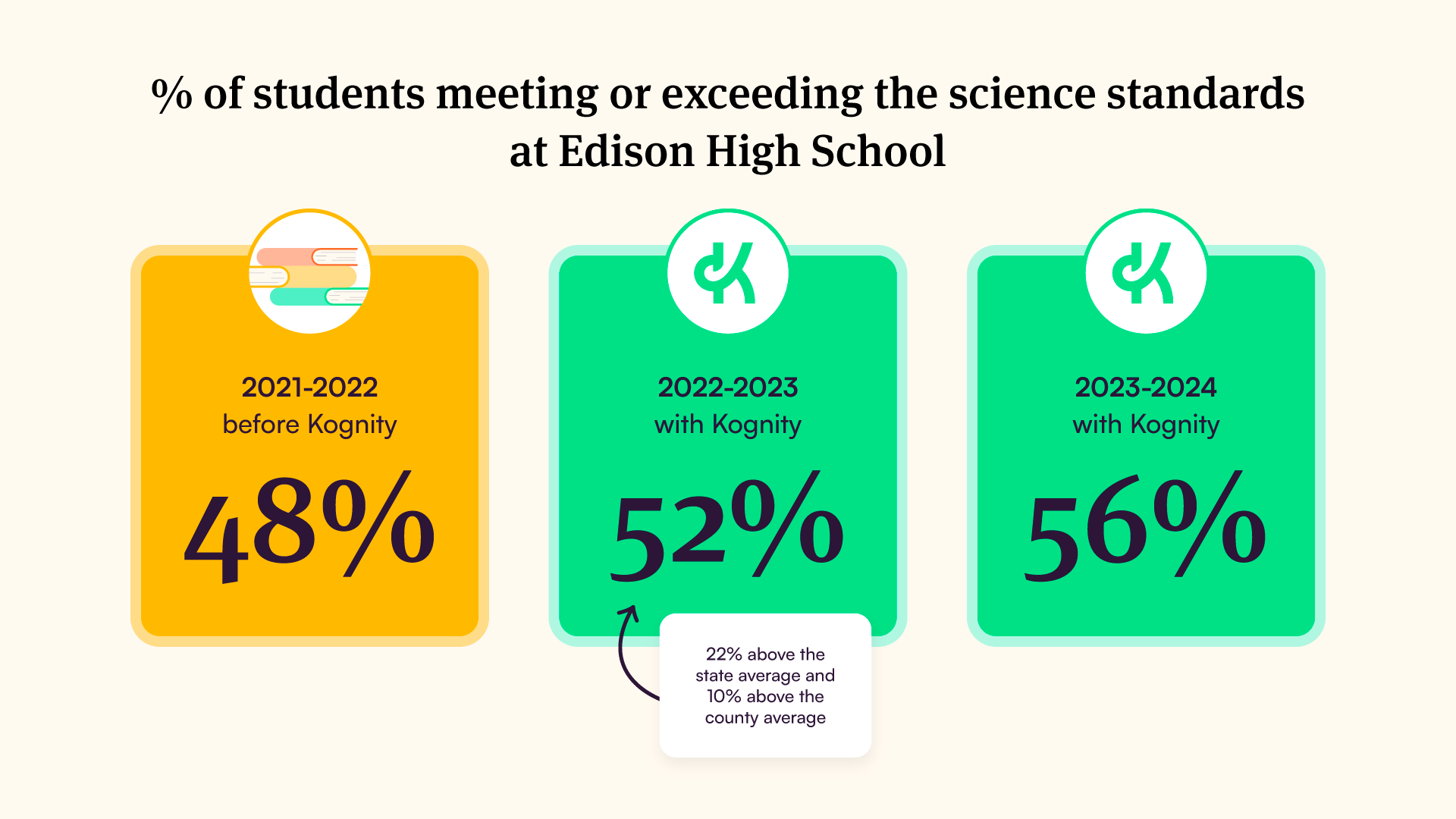
The California Science Test data provided it. In 2021–22, before Kognity, 48% of students at Edison met or exceeded the science standards. By 2022–23, the first full year with Kognity in Chemistry, that figure rose to 52.2%, with Edison students scoring 22% above the state average and 10% above the county average. By 2023–24, the met-and-exceeded rate reached 55.8% — a consistent upward trend across three consecutive years. Like any standardized assessment, the results reflect a range of factors, and April notes that student motivation on a non-graded test can vary. What the trend does show, though, is a school moving reliably in the right direction, year over year, as Kognity became embedded in the curriculum.
What that upward trend reflects, in part, is a department-wide shift. Kelly Kveton, Edison’s science department coordinator, oversees eleven teachers. She has watched Kognity take hold differently in each classroom: Chemistry teachers using it daily, blending the digital curriculum with hands-on labs they’ve run for years; a Physics teacher going almost entirely digital; Biology drawing on it as a source of inspiration and phenomena. “It’s been really fun watching the different teams choose the style of Kognity usage that works for them,” Kelly says. The flexibility provided by a curriculum that adapts to the teacher, and not the other way around, is a significant part of what makes the case for wider adoption.
For Kelly, Kognity’s value holds regardless of where a teacher is in their career. “It’s perfect for a brand new teacher who is diving in and trying to figure out their balance,” she says. “But it’s also good for the teacher who’s been teaching for a decade and needs new ideas or a little more support adapting what they’ve been doing.” April echoes that: “It has renewed my excitement for teaching because my students feel connected to the material. I have more confidence in my instruction because they understand why it’s important.”
No matter what teacher you’re talking about, Kognity takes what they’re doing and elevates it. It makes it more engaging, more authentically NGSS, in a way that’s highly supportive for teachers.
— Kelly Kveton, Science Department Coordinator, Edison High School
Customer Stories