How One Teacher’s Research Demonstrated Kognity’s Impact
Profile
Agrix Neri Go is the Head of Mathematics at Shanghai United International School (SUIS), Gubei Campus, in Shanghai, China. He has been teaching at the school for eight years, specialising in IB DP Mathematics: Analysis and Approaches and Cambridge IGCSE™ Additional Mathematics.
SUIS is an international school serving a diverse, multinational student community. The school offers the IB DP and Cambridge IGCSE curricula, emphasising critical thinking, student wellbeing, and cultural collaboration. Agrix is also currently completing a doctoral degree in education, with a research focus on digital learning tools and mathematical thinking.
Snapshot
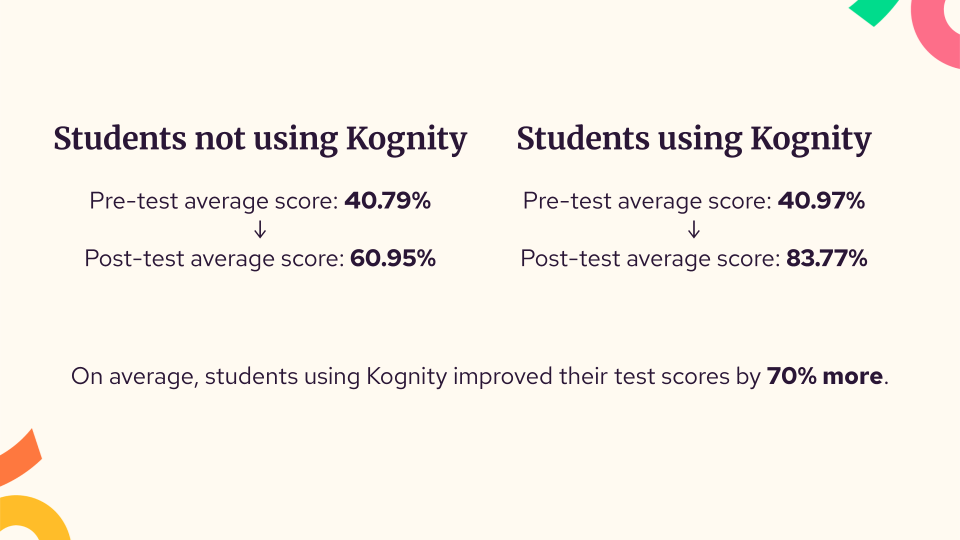
In a semester-long study of 44 IB DP Mathematics students, those learning with Kognity showed 70% greater improvement than students taught using traditional methods alone. The Kognity group’s average scores rose from 49.57% to 83.77%, while the traditionally taught group improved from 40.79% to just 60.95%. By the end of the study, 100% of students using Kognity achieved a Grade 6 or above — up from just 30.43% at the start. Beyond test performance, the research also found meaningful gains in student confidence and self-efficacy.
Key Challenges
- Time-consuming material preparation: Sourcing quality, curriculum-aligned resources for complex IB DP Calculus topics could take hours or an entire day.
- Traditional teaching produced limited improvement: Lecture-based instruction alone yielded only moderate gains in students’ mathematical thinking skills, particularly in areas like modeling and problem solving.
- Students lacked confidence and independence: Students struggled to study complex Calculus topics independently and needed more support for self-directed learning and revision.
- No evidence base for digital tool adoption: The school had adopted Kognity successfully, but Agrix wanted concrete data to show that it really was making a measurable difference.
Finding the Time — and the Right Resources — for Complex Topics
Under the IB DP syllabus, Calculus carries 50 hours of required teaching time — a demanding allocation for a subject known for its complexity. For Agrix, one of the biggest daily challenges was the time spent preparing materials. Browsing for appropriate resources online, cross-referencing them against the syllabus, and ensuring quality could consume an hour or more, sometimes an entire day.
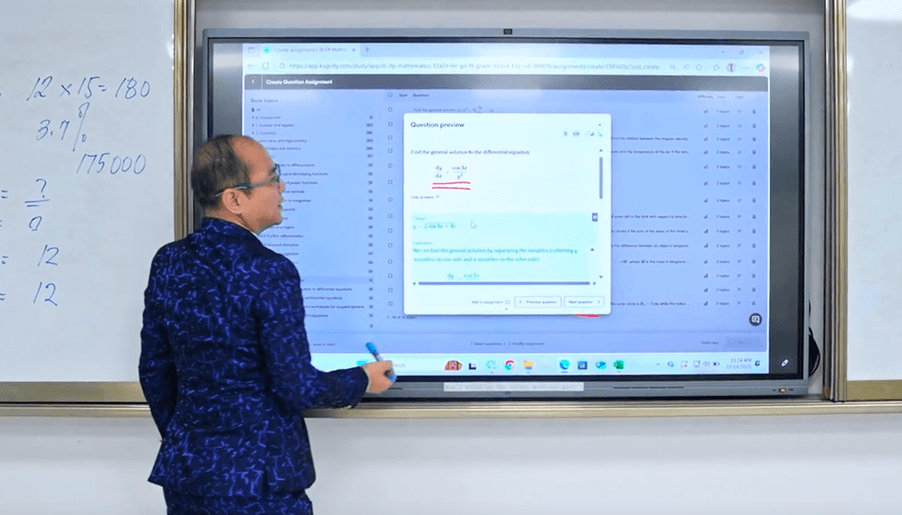
Kognity changed that. Because the platform’s content is fully aligned with the IB DP and IGCSE syllabi, Agrix no longer needed to spend hours hunting for resources. Kognity’s curriculum-aligned textbook materials, question bank, and assignable reading tasks gave him ready-made, high-quality content he could trust.
The time saved on preparation opened up something more valuable: time with students. Rather than spending planning periods sourcing content, Agrix could redirect that energy toward giving feedback, facilitating discussion, and engaging collaboratively with his classes.
Kognity saves a lot of time, particularly in preparing our materials. It has its own question bank that we can use to measure students’ attainment and performance.
— Agrix Neri Go, Head of Mathematics, SUIS Gubei Campus
Moving Beyond Traditional Teaching to Deepen Mathematical Thinking
Agrix had long observed that traditional instruction, while providing a solid foundation, only took students so far when it came to deeper mathematical thinking — the ability to reason logically, identify patterns, verify conclusions, and connect abstract concepts to the real world. His research confirmed this: students in the control group, taught traditionally, improved from an average of 40.79% to 60.95%. Progress, but limited.
The data from the students using Kognity told a different story. Their average scores rose from 49.57% to 83.77% — a 70% greater improvement. Every single student in the Kognity group finished the semester at grade 6 or above, with nearly three-quarters achieving the highest grade of 7. The statistical analysis showed this difference was highly significant, not a matter of chance.
What made the difference? Kognity enabled a blended learning approach. Students could study at their own pace before class using Kognity’s reading materials and practice questions, then come to lessons ready for deeper collaborative engagement.
It’s not just how they perform in terms of computations, but what they actually know. It’s about combining analytical, critical thinking with their actual performance.
— Agrix Neri Go, Head of Mathematics, SUIS Gubei Campus
Building Student Confidence and Independence
Beyond test scores, Agrix’s research uncovered something that mattered just as much: a significant improvement in student confidence and self-efficacy. Before the intervention, many students struggled to engage with complex Calculus independently. They needed a teacher present to guide every step.
Kognity gave students a safe space to practice, strengthen, and revisit content for true mastery. The platform’s in-depth explanations and video materials meant students could work through difficult material without waiting for a teacher. They could highlight important notes, save them as revision material, and return to topics as many times as needed.
Kognity gives students a chance to understand what is actually being processed during the lessons. Kids are able to reflect on their own: ‘I made a mistake on this, so I need to do this.’
— Agrix Neri Go, Head of Mathematics, SUIS Gubei Campus
This reflective process transformed how students approached learning. Rather than passively receiving content, they became active, independent learners. “Students love to work more independently using Kognity,” Agrix notes. “Sometimes they prefer to watch the video explanations on their own rather than listening to the teacher, because the explanations Kognity provides are very detailed.”
Evidence-Based Confidence in a Digital Tool
When SUIS adopted Kognity in 2022, Agrix was curious. The platform looked promising, but he wanted more than assumptions — he wanted proof. “I was so curious about what the impact of Kognity would be,” he recalls. “I had in my mind that there should be evidence-based research.”
As part of his doctoral dissertation, Agrix designed a quasi-experimental study involving 44 IB DP students taking Mathematics: Analysis and Approaches (Higher Level). One group of 21 students received traditional instruction; another group of 23 used Kognity as part of their learning over the course of a full semester. Both groups sat pre-tests and post-tests assessing mathematical thinking skills across five dimensions: induction, deduction, proof, modelling, and problem solving.
The results exceeded his expectations. The Kognity group’s improvement was so pronounced that Agrix shared his findings in professional development workshops at the school, leading colleagues in the mathematics department to adopt the platform more actively.
The results of my research exceeded my expectations. My findings gave me more confidence — not just as a teacher, but in how to be more innovative with technology.
— Agrix Neri Go, Head of Mathematics, SUIS Gubei Campus
His study, Effectiveness of Digital Textbook (Kognity) on The Mathematical Thinking Skills of Grade 12 Students in Shanghai China, was published in the International Journal of Research and Innovation in Social Science in January 2025, adding peer-reviewed evidence to what he had seen in his own classroom.
Consistency Is Key
When asked what advice he would give to other educators considering Kognity, Agrix returns to a single word: consistency. His next goal is to explore the long-term impact of Kognity across other subjects, including the sciences and economics, to see whether the gains he documented in mathematics extend to other areas of the IB DP curriculum.
For Agrix, the evidence is clear: Kognity isn’t just a resource. It’s a tool that, used consistently, can transform how students think, learn, and grow.
If we consistently provide Kognity to our students, we can improve their learning.
— Agrix Neri Go, Head of Mathematics, SUIS Gubei Campus
Customer Stories